By Ken Tucker (Kendall Saville) · Updated by the OnlineBlackjack.com editorial team
Editorially reviewed: October 30, 2026.
House edge is a long-run mathematical expectation under stated rules and a stated playing strategy. It is not the percentage you must lose each visit, a limit on losses, or the same statistic as a casino’s reported win divided by cash dropped at the tables.
What does a 0.5% house edge mean?
For an illustrative game with a 0.5% edge measured against original wagers, 100 hands at an initial bet of $10 create $1,000 of initial action. The expected loss is $1,000 × 0.005 = $5. This is arithmetic using an assumed edge, not a quote for every blackjack table.
You can win, lose much more than $5, or finish close to even. Splits and doubles require extra money during play; do not confuse your starting bankroll, cumulative action and expected loss. Changing stakes after a loss does not change the underlying expectation.
What does half a percent actually mean?
English narration and on-screen captions. Illustrative examples use practice chips with no cash value.
Read the video transcript
Does a half-percent house advantage mean you will lose just five chips from a thousand-chip bankroll? No. First, we need to define what the percentage is measured against.
Imagine one hundred rounds, each starting with ten practice chips. That is one thousand chips of initial-wager turnover: the sum of those starting bets. It is not the bankroll you need, because the same chips can be wagered again. For this hypothetical example, assume a house advantage of half a percent measured against original wagers. One thousand times zero point zero zero five gives five chips of expected loss. Expected does not mean scheduled: a particular session can finish well above or below that figure. Five chips is not a loss limit. Splitting and doubling can put more chips at risk. Those extra wagers do not change the denominator we chose for this example.
Always check how a quoted house advantage is defined and which rules it assumes. It describes a long-run average, not a promise about your next session.
How table rules change the edge
The following figures are approximate changes in the house edge, in percentage points. They reverse the sign of the player-return effects in the source. They are rule comparisons, not standalone house edges.
Selected rule effects
Change from the reference rules
Approximate increase in house edge
Blackjack pays 6:5 instead of 3:2
+1.39 percentage points
Dealer hits soft 17 instead of standing
+0.22 percentage points
Doubling after a split is not allowed
+0.14 percentage points
The source uses a reference game; deck count and other rules affect the exact result. Do not simply add these figures to an advertised edge or assume all effects combine without interaction. Wizard of Odds rule-variation analysis
3:2 versus 6:5 in cash
On a $20 qualifying blackjack, 3:2 pays $30 profit; 6:5 pays $24. The difference is $6 on that result. This payout comparison is not a $6 charge on every hand, and a normal 21 made with three cards is not a two-card blackjack.
Calculate the game you are actually playing
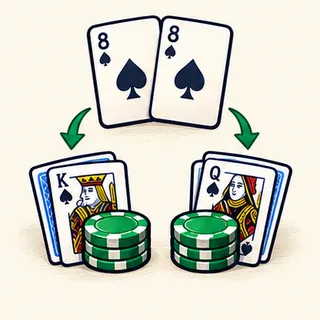
Record deck count, soft-17 rule, blackjack payout, double restrictions, split rules, surrender and how dealer blackjack is handled. Then choose the matching strategy chart. The Wizard of Odds calculator distinguishes strategy and shuffle assumptions; use the result that matches the game rather than mixing outputs.
In a 2017 post we reported on a Wizard of Odds study comparing online blackjack games from several software providers, with house edges ranging from 0.21% for Cryptologic’s single-deck game to 1.28% for Amigotech’s 6:5 game. Those figures date from 2017, so check the rules of the game you play.
Expected loss is not a session forecast
A lower edge improves the mathematical comparison, but stake size and the amount of play also matter. A larger stake can outweigh a small improvement in rules. Budget only what you can afford to lose and stop at your chosen limits. Our bankroll guide explains risk; it does not make a negative-expectation game profitable.
Bonuses and side bets need separate checks
A headline bonus does not automatically reduce the edge of your main hand. Check eligible games, wagering requirements, maximum bets, withdrawal restrictions and expiry. Evaluate each side bet using its own pay table. Avoid carrying a main-game edge over to an unrelated wager.
 House edge is a long-run mathematical expectation under stated rules and a stated playing strategy. It is not the percentage you must lose each visit, a limit on losses, or the same statistic as a casino’s reported win divided by cash dropped at the tables.
 You can win, lose much more than $5, or finish close to even. Splits and doubles require extra money during play; do not confuse your starting bankroll, cumulative action and expected loss. Changing stakes after a loss does not change the underlying expectation.
 Record deck count, soft-17 rule, blackjack payout, double restrictions, split rules, surrender and how dealer blackjack is handled. Then choose the matching
 A headline bonus does not automatically reduce the edge of your main hand. Check eligible games, wagering requirements, maximum bets, withdrawal restrictions and expiry. Evaluate each





 Bovada Casino