This independent practice table uses the configuration listed here. Insurance and optional side bets are omitted unless specifically listed. A fresh shoe is shuffled for each round. No money or prizes.
Community leaderboard
Top 20 completed sessions for this variation, ranked by profit from the starting 1,000 chips. Choose a nickname after 20 rounds to join everyone’s rankings. Browser-reported practice scores, not independently verified. No prizes.
Loading community scores…
Session complete
Your nickname, score, stake and submission date will be public. Use a nickname rather than your real name or email address.
Progress is saved automatically on this device between rounds. Community scores remain when you start again. Sound is optional and starts only after you enable it.
The practice table uses the configuration listed above. The guide below also discusses historical and casino-specific versions, whose rules may differ.
About this guide
Published by: Kdollar
Guide last edited: 30 October 2026
Practice rules: The practice rules appear above the table. Historical and casino versions can differ. Only supported decisions receive a coach grade.
Play Pontoon free in the table above, with virtual chips and coaching for this rule set. This is RTG-style British Pontoon, with both dealer cards hidden. It is not Australian Pontoon/Spanish 21, and ordinary dealer-up-card strategy cannot be used. Practice chips have no cash value.
How to use this game
Start a normal session with 1,000 virtual chips. Select 5, 10 or 25 chips per starting unit before the first deal. Some variations require more than one unit to begin a round; extra hands and doubles can add stakes.
Deal the cards, then make any special opening choice described below. Use only enabled actions. Hit takes a card, Stand ends that hand, Double adds an equal stake and follows this table’s draw rule, and Split creates another hand when allowed. Play each active hand in turn.
Coach tips can be switched off. Only supported decisions receive an accuracy grade; specialist choices can remain ungraded. A winning hand does not prove a correct decision. Quiz replays of saved mistakes do not change the game’s chips or leaderboard.
A normal practice session lasts 20 rounds. Progress is saved in this browser between rounds; finish the hand before leaving. Start a new session between hands to reset its chips. Completed normal sessions can be submitted to the casual public leaderboard with a chosen nickname.
Open the walkthrough for help without automatic play. Share results only if you want to: text and image cards contain rounds, graded accuracy and a page or challenge link, not bankroll, nickname or mistakes.
A new challenge opens a fresh, reproducible 20-round session with a fixed 10-chip unit. It has separate saved progress and does not enter the public leaderboard. The same link resumes that challenge on this browser; its reset restarts the same seed. Initial deals match; later cards depend on decisions.
Every round uses a newly shuffled shoe. This game is not a continuous-shoe counting drill.
Rules at this practice table
Opening stake: 1 starting unit(s) per round. Extra stakes may be needed for splits, doubles or attack choices.
Practice shoe: 8 × 52-card decks. A new shoe is shuffled every round.
Dealer cards: Both cards are hidden; the dealer checks the initial hand for pontoon.
Dealer drawing rule: Hit soft 17 (H17). The dealer also stops at five cards.
Card values: Aces count as 1 or 11; J, Q and K count as 10. A soft total uses an ace as 11.
Natural payout: 2:1 profit on a winning natural. A two-card 21 after splitting is also a pontoon.
Ties and priority: The dealer wins tied totals and tied five-card hands. A winning pontoon or five-card hand pays 2:1.
Doubling: Two to four cards. Allowed after splitting, subject to split-ace restrictions. You may hit after doubling.
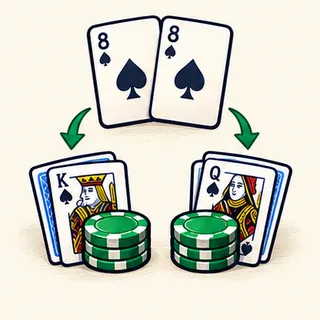
Splitting: Both cards must have the same rank; J–Q cannot be split. Maximum 3 hands in total.
Split aces: May be played normally and resplit within the hand limit.
Surrender / rescue: Not offered.
Ratios and poker numbers describe profit per staked unit; a winning paid stake is returned separately. Free tokens return winnings only.
Special decisions and payouts
RTG-style British Pontoon. Both dealer cards hidden; dealer checks for pontoon first. Stick only on 15+. Pontoon outranks five cards, which outrank other hands. Ties lose; winning pontoons and five-card hands pay 2:1.
Use Twist to take a card, Stick to stand from 15, or Buy to double with two to four cards. Buying is allowed once per hand and you can Twist afterwards. Both dealer cards stay hidden until settlement. Splits require identical ranks and the practice limit is three hands.
Pontoon rules in this game
RTG-style British Pontoon. Both dealer cards hidden; dealer checks for pontoon first. Stick only on 15+. Pontoon outranks five cards, which outrank other hands. Ties lose; winning pontoons and five-card hands pay 2:1.
The dealer checks for pontoon before player actions. Pontoon means an ace and a ten-value card in two cards, not every total of 21. Pontoon outranks a five-card hand, which outranks an ordinary hand; ties within these classes go to the dealer. Winning pontoons and five-card hands pay 2:1.
A rule example to try
You cannot stick below 15. Buying doubles the wager but still permits later twists. A five-card 18 outranks an ordinary three-card 21, but loses to dealer pontoon or a dealer five-card hand. A fifth non-bust card is therefore not an unconditional immediate win.
Can eighteen beat twenty-one?
English narration and on-screen captions. Illustrative examples use practice chips with no cash value.
Read the video transcript
Can eighteen beat twenty-one? In our Pontoon practice game, the kind of hand matters before the total.
Both dealer cards start face down. A pontoon is an ace and a ten-value card in the first two cards. It ranks above a five-card hand that has not gone over twenty-one. That five-card hand ranks above an ordinary hand. For example, three, four, two, four and five make eighteen in five cards. That beats the dealer’s ordinary three-card twenty-one. But it loses to a dealer five-card hand. A dealer pontoon ends the round before you draw. Ties go to the dealer here. So drawing a fifth card does not guarantee a win, and going over twenty-one still loses.
This is the rule set of our practice table, not every game called Pontoon. Check the hand rankings and tie rules before playing.
Learn the decisions, then compare the rules
The coach explains the special rules; it does not grade every decision in this variant. Use the specialist reference linked at the table for decisions beyond its supported advice. Compare Spanish 21, or browse all 26 free blackjack games. For the foundations, see basic blackjack strategy.
These notes describe this practice configuration. Casino versions can differ in payouts, splitting, doubling and side bets; check their rules before using a chart. Our online blackjack guide connects practice, strategy and casino reviews.
 The practice table uses the configuration listed above. The guide below also discusses historical and casino-specific versions, whose rules may differ.
 These notes describe this practice configuration. Casino versions can differ in payouts, splitting, doubling and side bets; check their rules before using a chart. Our




 Bovada Casino