This independent practice table uses the configuration listed here. Insurance and optional side bets are omitted unless specifically listed. A fresh shoe is shuffled for each round. No money or prizes.
Community leaderboard
Top 20 completed sessions for this variation, ranked by profit from the starting 1,000 chips. Choose a nickname after 20 rounds to join everyone’s rankings. Browser-reported practice scores, not independently verified. No prizes.
Loading community scores…
Session complete
Your nickname, score, stake and submission date will be public. Use a nickname rather than your real name or email address.
Progress is saved automatically on this device between rounds. Community scores remain when you start again. Sound is optional and starts only after you enable it.
The practice table uses the configuration listed above. The guide below also discusses historical and casino-specific versions, whose rules may differ.
About this guide
Published by: Kdollar
Guide last edited: 12 November 2026
Practice rules: The practice rules appear above the table. Historical and casino versions can differ. Only supported decisions receive a coach grade.
Play Double Attack Blackjack free in the table above, with virtual chips and coaching for this rule set. Double Attack lets you increase the starting wager after seeing the dealer up-card. This decision comes before the normal play of your completed hand. Practice chips have no cash value.
How to use this game
Start a normal session with 1,000 virtual chips. Select 5, 10 or 25 chips per starting unit before the first deal. Some variations require more than one unit to begin a round; extra hands and doubles can add stakes.
Deal the cards, then make any special opening choice described below. Use only enabled actions. Hit takes a card, Stand ends that hand, Double adds an equal stake and follows this table’s draw rule, and Split creates another hand when allowed. Play each active hand in turn.
Coach tips can be switched off. Only supported decisions receive an accuracy grade; specialist choices can remain ungraded. A winning hand does not prove a correct decision. Quiz replays of saved mistakes do not change the game’s chips or leaderboard.
A normal practice session lasts 20 rounds. Progress is saved in this browser between rounds; finish the hand before leaving. Start a new session between hands to reset its chips. Completed normal sessions can be submitted to the casual public leaderboard with a chosen nickname.
Open the walkthrough for help without automatic play. Share results only if you want to: text and image cards contain rounds, graded accuracy and a page or challenge link, not bankroll, nickname or mistakes.
A new challenge opens a fresh, reproducible 20-round session with a fixed 10-chip unit. It has separate saved progress and does not enter the public leaderboard. The same link resumes that challenge on this browser; its reset restarts the same seed. Initial deals match; later cards depend on decisions.
Every round uses a newly shuffled shoe. This game is not a continuous-shoe counting drill.
Rules at this practice table
Opening stake: 1 starting unit(s) per round. Extra stakes may be needed for splits, doubles or attack choices.
Practice shoe: 8 × 48-card decks. A new shoe is shuffled every round. Numeral tens are removed; J, Q and K remain.
Dealer cards: One up-card and one hidden card; an ace or ten-value up-card is checked for blackjack before ordinary play.
Dealer drawing rule: Stand on every 17 (S17).
Card values: Aces count as 1 or 11; J, Q and K count as 10. A soft total uses an ace as 11.
Natural payout: 1:1 profit on a winning natural. A split-hand 21 is not a natural.
Ties and priority: Ordinary equal totals push. Two original naturals push.
Doubling: Any number of cards below 21, once per hand. Allowed after splitting, subject to split-ace restrictions. Doubling takes one card; then stand or use an offered rescue/replacement choice.
Splitting: Both cards must have equal blackjack value; different ten-value ranks can be split. Maximum 4 hands in total.
Split aces: One new card per ace, then stand.
Surrender / rescue: Use Surrender only when the button is enabled and the total is below 21. It returns half the hand’s paid stake. After doubling, Rescue double returns half the total paid stake.
Ratios and poker numbers describe profit per staked unit; a winning paid stake is returned separately. Free tokens return winnings only.
Special decisions and payouts
See the dealer up-card before choosing an extra starting wager. Spanish decks, S17 and 1:1 naturals. Double or surrender after any number of cards.
First see the dealer’s up-card. Add one equal unit or continue without it; then your two-card hand is dealt. This game uses eight Spanish decks, stands on soft 17 and pays ordinary winning naturals 1:1. A later double adds an amount equal to the current main-hand stake.
Double Attack Blackjack rules in this game
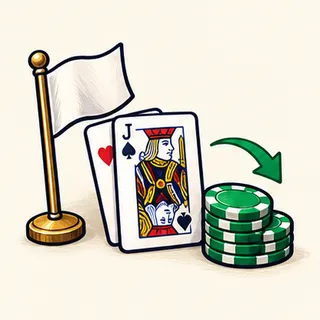
See the dealer up-card before choosing an extra starting wager. Spanish decks, S17 and 1:1 naturals. Double or surrender after any number of cards.
The table uses eight Spanish decks, S17 and even-money naturals. It allows doubling or surrender after drawing when available, including double-down rescue. A split or double must account for the committed hand stake, not just the first starting unit.
A rule example to try
The coach’s opening betting guidance adds the equal Attack wager against dealer 2–8 and skips it against 9, a ten-value card or ace. After that choice, play the actual hand using Double Attack strategy; the extra wager is already committed.
Attack bet or double down: what changes?
English narration and on-screen captions. Illustrative examples use practice chips with no cash value.
Read the video transcript
An Attack bet and doubling down happen at different moments. Watch the stake in our Double Attack practice game.
Start with ten practice chips. The dealer’s six appears before you receive any cards. You may add another ten, or continue with just your original stake. Suppose you add it: twenty chips now back the same main hand. Only then do you receive a five and a six: eleven. If you later double, you add twenty more, not ten. Forty chips are now at risk, and you receive one double-down card. The Attack choice came before your hand; doubling came after. Neither guarantees a win.
This table uses eight forty-eight-card decks, with numbered tens removed but face cards retained. Check its specific rules and practise with chips that have no cash value.
Learn the decisions, then compare the rules
The coach explains the special rules; it does not grade every decision in this variant. Use the specialist reference linked at the table for decisions beyond its supported advice. Compare Triple Attack Blackjack, or browse all 26 free blackjack games. For the foundations, see basic blackjack strategy.
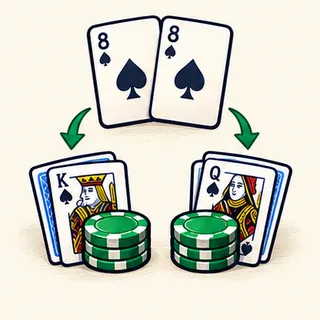
These notes describe this practice configuration. Casino versions can differ in payouts, splitting, doubling and side bets; check their rules before using a chart. Our online blackjack guide connects practice, strategy and casino reviews.
 The practice table uses the configuration listed above. The guide below also discusses historical and casino-specific versions, whose rules may differ.
 See the dealer up-card before choosing an extra starting wager. Spanish decks, S17 and 1:1 naturals. Double or surrender after any number of cards.
 These notes describe this practice configuration. Casino versions can differ in payouts, splitting, doubling and





 Bovada Casino