Card counting is a way of tracking which cards have left the shoe so you can tell when the remaining cards favor you. When the shoe is rich in tens and aces, you bet more. When it is not, you bet the minimum. It is not memorizing every card, and it does not require a genius-level memory. It is simple addition and subtraction, done quietly and consistently.
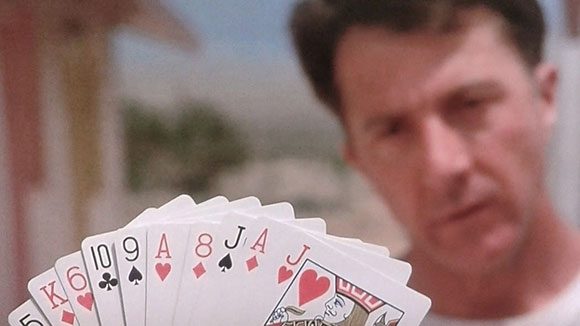
Films like Rain Man suggest counters call out every card and clean out the casino. The reality is far more modest. Counting gives a disciplined player a small edge over the house, usually a fraction of one percent to around one percent, and results are still volatile in the short run. This guide explains how counting works, shows you how to count cards in blackjack step by step with the Hi-Lo system, and compares the main counting systems so you can pick the right one.
How Card Counting Works
Casino blackjack is usually dealt from a shoe of six or eight decks, and the dealer typically reshuffles after roughly 75% of the cards have been dealt. That means the cards already seen tell you something about the cards still to come.
Card counting was put on a scientific footing by mathematician Edward Thorp, whose 1962 book Beat the Dealer showed that tracking the cards can give the player an edge. Stanford Wong‘s Professional Blackjack (1975), built around the Hi-Lo count taught below, is still one of the standard references for counters.
The key fact is that high cards favor the player and low cards favor the dealer. Tens and aces help you in several ways:
More blackjacks. A natural pays you 3-2, while the dealer only collects your bet when they have one.
More dealer busts. You can stand on stiff hands such as 12 to 16, but the dealer must keep drawing. A ten-rich shoe makes dealer busts more likely.
Better doubles. A ten gives you a strong total when you double on 10 or 11.
Profitable insurance. When enough tens remain, the insurance bet turns from a bad bet into a good one.
Small cards do the opposite. They help the dealer complete stiff hands without busting. When many small cards have already come out, the remaining shoe is richer in tens and aces and is better for you.
You cannot change what the cards do, but you can change how much you bet. Most of a counter’s profit comes from betting more when the count is high and less when it is low. A smaller part comes from playing a few hands differently from basic strategy and from taking insurance only when the count says so.
How to Count Cards in Blackjack, Step by Step
The most popular method is the Hi-Lo system. It is a good place to start because it is accurate enough to give a real edge and simple enough to learn in a few weeks of practice. Here is the whole process.
Step 1: Learn basic strategy first
Counting only adds to a sound foundation. If you make avoidable mistakes in your play, they will cost you more than counting earns. Learn the basic strategy chart for the rules you play until the correct play is automatic. You can drill it for free in the Wizard of Odds blackjack game, which flags any play that differs from basic strategy.
Step 2: Learn the Hi-Lo card values
Every card is worth +1, 0 or -1. Low cards are positive because removing them from the shoe helps you. High cards are negative because removing them hurts you.
Cards
Hi-Lo value
Why
2, 3, 4, 5, 6
+1
Low cards leaving the shoe help you
7, 8, 9
0
Neutral, ignore them
10, J, Q, K, A
-1
High cards leaving the shoe hurt you
Step 3: Keep the running count
Start at zero with a fresh shoe. Add each card’s value as it is dealt to anyone at the table, including the dealer and the other players. You do not need to track individual cards, just the single running total.
For example, suppose the first round shows 5, K, 3, 9, 2, 10, 6 and A. The values are +1, -1, +1, 0, +1, -1, +1 and -1, so the running count is +1. A positive count means more high cards remain than expected. A negative count means fewer.
Cancel pairs as you go instead of adding every card one by one. A low card and a high card cancel to zero. Counting two cards at a time in this way is much faster, and it is the habit you build when you practice.
Step 4: Convert to the true count
The running count means different things depending on how many cards are left. A running count of +6 with one deck remaining is very strong. The same +6 with five decks remaining is only a mild lean. To fix this, convert to a true count:
True count = running count / decks remaining
Estimate the decks remaining by looking at the discard tray and judging how much is left. Rounding to the nearest half deck is accurate enough. For example, a running count of +6 with three decks left gives a true count of +2. Many players round down toward zero so they stay conservative.
Step 5: Raise your bet as the true count rises
This is where the money is made. At a true count of +1 or less, bet your minimum unit. As the true count rises, bet more. A simple spread might run from one unit at +1 or below up to eight units at +5 or higher, but the right ramp depends on the table limits, the number of decks and how much attention you can tolerate. Our guide to the betting spread explains how to build one that suits your bankroll, and the betting strategies page covers related approaches.
As a rule of thumb, each +1 in the true count moves your expected return by roughly half a percent. Because basic strategy leaves the house with an edge of around half a percent in a typical shoe game, you generally need a true count of about +1 to start playing at an advantage. At a negative count, bet the minimum or leave the table.
Step 6: Use basic strategy, plus a few index plays
For most hands, play basic strategy. Once you are comfortable with the count, you can improve your results by changing a small number of plays when the true count crosses a set number. These are called index plays, or deviations. The best known set is the “Illustrious 18”, the eighteen deviations that add the most value. A few examples with Hi-Lo:
Insurance: take it at a true count of +3 or higher.
16 against a dealer 10: stand at a true count of 0 or higher, instead of hitting.
15 against a dealer 10: stand at +4 or higher.
12 against a dealer 3: stand at +2 or higher.
10 against a dealer 10: double at +4 or higher.
The exact index numbers vary a little with the rules and number of decks, so check them against a reliable chart for your game. Do not try to learn all of them at once. Insurance and 16 against 10 are worth the most, so start with those.
How to Practice Card Counting
Understanding the system takes an hour. Making it automatic takes weeks, and the practice is where most people give up. Blackjack training software can also drill you on specific situations. Work through these stages in order:
Count down a single deck. Shuffle a deck, then turn the cards over one or two at a time and keep the running count. A correctly counted full deck ends on exactly zero. Repeat until you can do it in under 30 seconds and finish at zero every time.
Add distractions. Do the same drill with the television on or someone talking to you. A casino is noisy, and you will have to count while you play, chat and handle chips.
Deal practice hands. Deal hands to yourself and a few imaginary players, play them out with basic strategy and keep the count as you go.
Practice the true count. Deal part of a multi-deck shoe, then estimate the decks remaining and convert the running count.
Use a trainer. Our free blackjack game includes a card counting trainer, so you can practice the count in a realistic game without risking money.
You can test what you have learned with our card counting true or false quiz. Most people need several weeks of regular, short sessions before they are ready for a casino. For a one-page summary of the method, see our card counting infographic. Do not play with real money until you can count a full deck accurately and quickly with distractions around you.
Card Counting Systems Compared
Search for blackjack counting systems and you will find many options. They all work in the same way: each card gets a value, you keep a running total and you adjust your bets. They differ in how many values they use (the level), whether a full deck adds up to zero (balanced or unbalanced) and how hard they are to use.
A licensed method whose full rules are not published
Levels, balanced and unbalanced counts
The level is the largest value any card carries. A level 1 system uses only +1, 0 and -1. A level 2 system also uses +2 and -2, and a level 3 system uses more values still. Higher levels measure the shoe more precisely, but every extra value is another chance to make a mistake.
In a balanced count, a full deck adds up to zero, so you divide by the decks remaining to get the true count. An unbalanced count, such as Knock-Out, does not return to zero. It is designed so that you can compare the running count with a fixed target number, which avoids the division. That makes it easier at the table, though it is slightly less precise when the number of decks changes.
Which system should you use?
For almost everyone, the answer is Hi-Lo. It is easy enough to master and strong enough that moving to a more complex system adds only a small gain. If you find the true count division awkward, Knock-Out is a good alternative. If you want the simplest approach and are happy with a smaller edge, try Ace-Five.
Choose the system you can use without errors. A simple system played perfectly beats a complex system played with mistakes, because a few miscounts can erase the whole advantage. You can move up to Zen or another higher-level count later, once Hi-Lo feels automatic.
Can You Count Cards Online?
Almost never. Counting only works if cards that leave the shoe stay out until a reshuffle. Online:
RNG (computer-dealt) blackjack shuffles after every hand, or deals from an effectively endless supply of cards. The past cards have no effect on the next ones, so there is nothing to count.
Live dealer blackjack uses real cards, but many tables use eight decks and shuffle after about half the shoe has been dealt. With so few cards removed before the reshuffle, the count rarely gets high enough to give you a meaningful edge.
Live dealer games are the closest online equivalent to a casino, so they are the only place where counting is even possible. Read our live dealer blackjack guide to see how those games are dealt. If you do try to count, check how deep the dealer deals before you commit any money. Lower penetration means less opportunity, and some tables use automatic shuffling machines which remove it altogether.
Is Card Counting Legal? Risks to Know About
Counting cards in your head is not illegal. You are only using your own brain and the cards that are visible to everyone. Using a device to help you count is a different matter and can be a crime in some places. Read Is Counting Cards Illegal? for the details.
Legal does not mean welcome. Casinos are private businesses and can ask you to stop playing blackjack or leave at any time. They may also respond by shuffling earlier, which lowers penetration and removes your edge. Counters who bet in an obvious pattern are easy to spot, so many use a modest spread and avoid dramatic jumps in bet size. See how casinos catch card counters for the warning signs and countermeasures, and why card counting is not for everyone for an honest look at the downsides.
There are financial risks too. The edge is small, so results swing widely, and you can lose for a long time even when you play perfectly. You need a bankroll that can absorb those swings, typically many hundreds of betting units. Read our bankroll management guide before you decide how much to bring and how large your unit should be. Never play with money you cannot afford to lose.
No. Counting cards in your head is legal, since you are only using information that every player can see. Casinos can still ban you from playing, and using a device to count is treated differently. See our full guide on whether counting cards is illegal.
How much of an edge does card counting give you?
A well-executed count with a good bet spread can give a player an edge of around half a percent to one percent over the house, depending on the rules, number of decks and how deep the shoe is dealt. That is small, which is why bankroll and patience matter so much. It is not a guarantee of profit in any single session.
Do you need to be good at math to count cards?
No. Hi-Lo uses only adding and subtracting one, plus one division to get the true count. Speed and consistency matter more than math skill. Most people can learn it with a few weeks of regular practice.
Does card counting work with 6 or 8 decks?
Yes, but the edge is smaller than in a single or double-deck game. With more decks, each card removed shifts the odds less, so you spend more time at a neutral or negative count and need a wider spread to profit. Deck penetration matters as much as the number of decks. Our guide to the two-deck game shows why fewer decks help.
Can you count cards online?
Not in standard online blackjack, because the cards are reshuffled after every hand. Live dealer games are sometimes countable in principle, but the shuffle point is often too early to give a real edge. See the section above for the details.
What is the best card counting system for beginners?
Hi-Lo is the usual recommendation. It is simple, well documented and powerful enough for real play. Beginners who want something even easier can start with Ace-Five, or try Knock-Out to skip the true count conversion.
 Card counting is a way of tracking which cards have left the shoe so you can tell when the remaining cards favor you. When the shoe is rich in tens and aces, you bet more. When it is not, you bet the minimum. It is not memorizing every card, and it does not require a genius-level memory. It is simple addition and subtraction, done quietly and consistently.
 This is where the money is made. At a true count of +1 or less, bet your minimum unit. As the true count rises, bet more. A simple spread might run from one unit at +1 or below up to eight units at +5 or higher, but the right ramp depends on the table limits, the number of decks and how much attention you can tolerate. Our guide to the
 Live dealer games are the closest online equivalent to a casino, so they are the only place where counting is even possible. Read our






 Bovada Casino