Two ten-value cards make a strong starting hand. Splitting creates two separate wagers and replaces that known 20 with two uncertain hands. Advanced counting and tournament decisions require a different, explicitly defined objective.
“Ten-value cards” includes tens, jacks, queens and kings. Whether unlike ranks may be split is a table rule; permission to split does not make it the basic-strategy choice.
See what splitting does to your exposure
Suppose your original wager is 10 chips. Splitting adds another 10-chip wager, so 20 chips are now exposed before any further action.
Illustrative split outcomes at even money
Result of two hands
Net result
Both win
+20 chips
One wins; one loses
0 chips
Both lose
−20 chips
One wins; one pushes
+10 chips
This table illustrates settlement, not the probability of each outcome or an argument for splitting. Keeping the original hand exposes 10 chips; the split outcomes are not a like-for-like estimate of the original hand’s expected value.
An ace received after splitting a ten-value card usually makes an ordinary 21, not a natural blackjack. Check the table’s actual split-hand payout rules.
Why you may hear about exceptions
Count-based deviations
The published Hi-Lo Illustrious 18 reference lists splitting tens against a dealer 5 at true count +5, and against a 6 at +4. These are specific index decisions, not a universal “split at +5” instruction.
A tournament can reward finishing ahead of another player rather than maximizing the expected return of one hand. Scores, remaining hands, wager limits and the advancement rules can change the objective.
That does not turn a tournament tactic into ordinary cash-game basic strategy.
Do not use an advanced exception to justify an unrecorded hunch. If you cannot identify the system, table rules and decision threshold, return to the matching basic-strategy chart.
Practise explaining the decision
Identify the hand: two ten-value cards, hard 20.
Read the dealer’s upcard and the table rules.
Use the matching chart; for the standard basic-strategy case, stand.
Review the decision independently of the result. A correct stand can still lose.
No. The dealer can make 21, and another 20 normally pushes. A recommended decision maximizes expected value under its assumptions; it does not guarantee the outcome.
Should I copy someone who won after splitting tens?
No. One result does not establish that the decision was best. Compare the decision with the rules and strategy, not the celebration afterward.

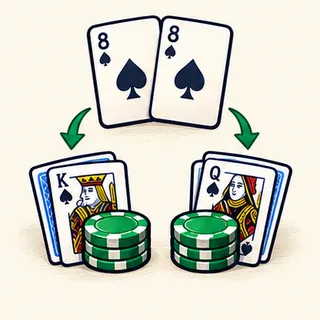 Two ten-value cards make a strong starting hand. Splitting creates two separate wagers and replaces that known 20 with two uncertain hands. Advanced counting and tournament decisions require a different, explicitly defined objective.
 The
 The published Hi-Lo Illustrious 18 reference lists splitting tens against a dealer 5 at true count +5, and against a 6 at +4. These are specific index decisions, not a universal “split at +5” instruction.
 Bovada Casino