This independent practice table uses the configuration listed here. Insurance and optional side bets are omitted unless specifically listed. A fresh shoe is shuffled for each round. No money or prizes.
Community leaderboard
Top 20 completed sessions for this variation, ranked by profit from the starting 1,000 chips. Choose a nickname after 20 rounds to join everyone’s rankings. Browser-reported practice scores, not independently verified. No prizes.
Loading community scores…
Session complete
Your nickname, score, stake and submission date will be public. Use a nickname rather than your real name or email address.
Progress is saved automatically on this device between rounds. Community scores remain when you start again. Sound is optional and starts only after you enable it.
The practice table uses the configuration listed above. The guide below also discusses historical and casino-specific versions, whose rules may differ.
About this guide
Published by: Kdollar
Guide last edited: 12 November 2026
Practice rules: The practice rules appear above the table. Historical and casino versions can differ. Only supported decisions receive a coach grade.
Play Super Fun 21 free in the table above, with virtual chips and coaching for this rule set. Super Fun 21 offers special wins in exchange for an even-money ordinary natural. This single-deck table also allows decisions after drawing that ordinary blackjack may forbid. Practice chips have no cash value.
How to use this game
Start a normal session with 1,000 virtual chips. Select 5, 10 or 25 chips per starting unit before the first deal. Some variations require more than one unit to begin a round; extra hands and doubles can add stakes.
Deal the cards, then make any special opening choice described below. Use only enabled actions. Hit takes a card, Stand ends that hand, Double adds an equal stake and follows this table’s draw rule, and Split creates another hand when allowed. Play each active hand in turn.
Coach tips can be switched off. Only supported decisions receive an accuracy grade; specialist choices can remain ungraded. A winning hand does not prove a correct decision. Quiz replays of saved mistakes do not change the game’s chips or leaderboard.
A normal practice session lasts 20 rounds. Progress is saved in this browser between rounds; finish the hand before leaving. Start a new session between hands to reset its chips. Completed normal sessions can be submitted to the casual public leaderboard with a chosen nickname.
Open the walkthrough for help without automatic play. Share results only if you want to: text and image cards contain rounds, graded accuracy and a page or challenge link, not bankroll, nickname or mistakes.
A new challenge opens a fresh, reproducible 20-round session with a fixed 10-chip unit. It has separate saved progress and does not enter the public leaderboard. The same link resumes that challenge on this browser; its reset restarts the same seed. Initial deals match; later cards depend on decisions.
Every round uses a newly shuffled shoe. This game is not a continuous-shoe counting drill.
Rules at this practice table
Opening stake: 1 starting unit(s) per round. Extra stakes may be needed for splits, doubles or attack choices.
Practice shoe: 1 × 52-card decks. A new shoe is shuffled every round.
Dealer cards: One up-card and one hidden card; an ace or ten-value up-card is checked for blackjack before ordinary play.
Dealer drawing rule: Hit soft 17 (H17).
Card values: Aces count as 1 or 11; J, Q and K count as 10. A soft total uses an ace as 11.
Natural payout: 1:1 profit on a winning natural. Two diamonds pay 2:1. A split-hand 21 is not a natural.
Ties and priority: Ordinary equal totals push. Your original natural always wins.
Doubling: Any number of cards below 21, once per hand. Allowed after splitting, subject to split-ace restrictions. Doubling takes one card; then stand or use an offered rescue/replacement choice.
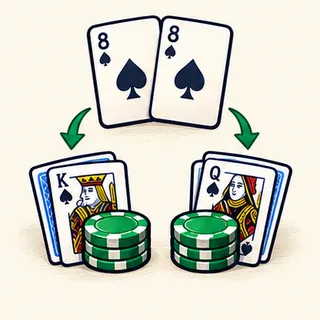
Splitting: Both cards must have equal blackjack value; different ten-value ranks can be split. Maximum 4 hands in total.
Split aces: May be played normally and resplit within the hand limit.
Surrender / rescue: Use Surrender only when the button is enabled and the total is below 21. It returns half the hand’s paid stake. After doubling, Rescue double returns half the total paid stake.
Automatic multi-card win: 6 or more cards with total at most 20 win automatically. Not after doubling; five-card-or-longer 21 pays 2:1 before doubling.
Ratios and poker numbers describe profit per staked unit; a winning paid stake is returned separately. Free tokens return winnings only.
Special decisions and payouts
Your natural always wins: 1:1, or 2:1 with two diamonds. Five-card 21 pays 2:1; six cards totalling 20 or less win. Long-hand awards exclude doubles.
Super Fun 21 rules in this game
Your natural always wins: 1:1, or 2:1 with two diamonds. Five-card 21 pays 2:1; six cards totalling 20 or less win. Long-hand awards exclude doubles.
A player natural always wins: ordinarily 1:1, or 2:1 when both cards are diamonds. Five-card 21 pays 2:1, and six cards totalling 20 or less win automatically. The long-hand awards do not apply after doubling.
A rule example to try
A five-card 20 is not the five-card 21 award and is not automatically a winner. A sixth card that keeps the total at 20 or less activates the six-card award if the hand has not doubled. This is why card count belongs in the decision.
Five cards: is that enough?
English narration and on-screen captions. Illustrative examples use practice chips with no cash value.
Read the video transcript
Does five cards always mean an automatic win? Not at our Super Fun Twenty-One practice table. The total, card count and whether you doubled all matter.
Take an undoubled hand: two, three, four, five and seven. That is five cards totaling twenty-one. Here, an undoubled twenty-one with five or more cards pays two to one. Change the example to five cards totaling twenty: there is no automatic award just for having five cards. A different rule applies to six or more cards totaling twenty or less: an undoubled hand wins automatically. Six-card twenty-one instead receives the two-to-one award. Six-card twenty-two is still a bust. Both special awards exclude doubled hands. Doubling does not automatically lose the hand; it removes these particular awards, so ordinary settlement applies.
These are the rules of this single-deck practice version. Check the exact table rules rather than relying on card count alone. Practice chips have no cash value.
Learn the decisions, then compare the rules
The coach explains the special rules; it does not grade every decision in this variant. Use the specialist reference linked at the table for decisions beyond its supported advice. Compare Most Liberal 21, or browse all 26 free blackjack games. For the foundations, see basic blackjack strategy.
These notes describe this practice configuration. Casino versions can differ in payouts, splitting, doubling and side bets; check their rules before using a chart. Our online blackjack guide connects practice, strategy and casino reviews.
 The practice table uses the configuration listed above. The guide below also discusses historical and casino-specific versions, whose rules may differ.
 These notes describe this practice configuration. Casino versions can differ in payouts, splitting, doubling and




 Bovada Casino