The house edge comes from the whole ruleset—not one bust statistic.
Players act before the dealer and lose their wager if they bust, even if the dealer later busts. That disadvantage is partly offset by player benefits such as blackjack payouts and well-chosen doubles and splits.
Why “both bust” is only part of the explanation
The order of play matters. A player who busts has already lost; a later dealer bust does not rescue that wager. But the player and dealer do not follow identical decision rules, and the game also contains blackjacks, pushes, doubles, splits and sometimes surrender.
Multiplying two generic bust percentages does not calculate the complete house edge. A proper calculation weights all relevant outcomes under a specified strategy and ruleset.
Player disadvantages
Busting ends the player’s main wager immediately. Restrictions on doubling, splitting and surrender can further limit useful choices.
Player benefits
A natural blackjack can pay more than an ordinary win. The player can choose when to double or split, while the dealer follows fixed drawing rules.
Turn a percentage into a useful example
Suppose a game has a 0.5% house edge measured against the initial wager, using the stated strategy. With 100 initial bets of $10, initial turnover is $1,000.
$1,000 × 0.005 = $5
That is a hypothetical long-run expected loss—not a prediction that a 100-hand session will finish $5 down.
The $1,000 figure is money wagered across hands, not the starting bankroll. A player may reuse the same chips many times. Split and double bets increase total action; do not switch denominators midway through the calculation.
Short sessions can produce much larger wins or losses than the average. A small house edge does not make an unaffordable stake safe.
Compare the rules before comparing a percentage
Wizard of Odds publishes approximate rule effects relative to an eight-deck game with S17, doubling on any first two cards, double after split and splitting to four hands, with strategy adjusted appropriately.
Selected changes under that reference model
Rule change
Approximate increase in house edge
Blackjack pays 6:5 instead of 3:2
1.39 percentage points
Dealer hits soft 17 instead of standing
0.22 percentage points
No doubling after splitting
0.14 percentage points
These are changes, not the resulting table’s total house edge. Treat combined changes as a reason to calculate the complete game, rather than assuming every effect can be added without interaction.
On a $10 natural, 3:2 pays $15 profit while 6:5 pays $12: a $3 difference each time that payout applies. Side bets have separate rules and expectations; they are not included in the main-game figure.
Reduce errors before increasing your stake
Use the strategy chart that matches your rules, compare the exact payout and read the table’s help panel. Changing bets after losses does not remove a negative expectation.
Is house edge the percentage of hands the casino wins?
No. It measures average net loss relative to a defined wager amount. Different payouts, pushes and extra wagers mean win frequency alone is insufficient.
Can I use a generic 0.5% figure for every blackjack game?
No. The example above is hypothetical. Rules and decisions determine the applicable figure.

 Players act before the dealer and lose their wager if they bust, even if the dealer later busts. That disadvantage is partly offset by player benefits such as blackjack payouts and well-chosen doubles and splits.
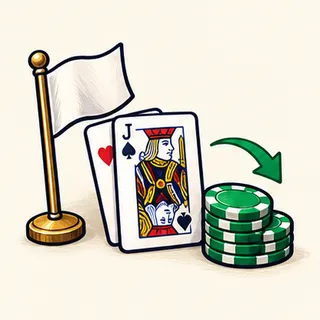 The order of play matters. A player who busts has already lost; a later dealer bust does not rescue that wager. But the player and dealer do not follow identical decision rules, and the game also contains blackjacks, pushes, doubles, splits and sometimes surrender.
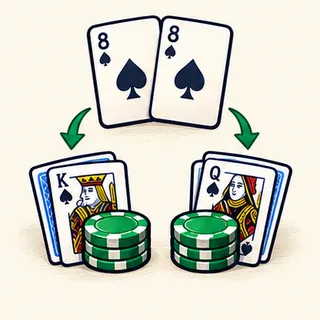 A natural blackjack can pay more than an ordinary win. The player can choose when to double or split, while the dealer follows fixed drawing rules.
 Suppose a game has a 0.5% house edge measured against the initial wager, using the stated strategy. With 100 initial bets of $10, initial turnover is $1,000.
 The $1,000 figure is money wagered across hands, not the starting bankroll. A player may reuse the same chips many times. Split and double bets increase total action; do not switch denominators midway through the calculation.
 On a $10 natural, 3:2 pays $15 profit while 6:5 pays $12: a $3 difference each time that payout applies. Side bets have separate rules and expectations; they are not included in the main-game figure.



 Bovada Casino