By Ken Tucker (Kendall Saville) · Updated by the OnlineBlackjack.com editorial team
Most players understand that the casino holds an advantage in blackjack. This advantage is known as the house advantage or house edge, and is usually under 1% in most blackjack games, provided players play using the optimal basic strategy under the rules of the game they’re playing.
What does the house edge or advantage mean? It is an expression of how much of each unit wagered that the casino can expect to win on average. In other words, if the house advantage is 1% and you make bets of $100, you can expect the casino to win $1 for every bet you make over the long run. The results of doubling down, splits, blackjacks and everything else are included in that calculation.
Obviously, no bet in blackjack would cause you to lose exactly $1 on any given $100 bet. However, if you played tens of thousands of hands, or looked at the aggregated results of thousands of customers playing at the casino, you would see that the casino was coming out ahead by about that 1% margin. This assumes of course that everyone plays perfect basic strategy. The reality is that casinos make more than that because of players that don’t know about basic strategy or prefer to gamble and bet with their gut when they are feeling lucky.
Blackjack Rules and the House Edge
Not surprisingly, different blackjack rules can have an impact on the size of the house edge. Some rules variations are beneficial to the player, while others increase the casino’s advantage.
The following is a rundown of how different rule changes can affect the house advantage. Credit to The Wizard of Odds for their excellent analysis of how rules affect the casino’s advantage. All rule changes and their effects are rated against a typical game with the following rules: a blackjack game with an eight deck shoe, where the dealer stands on all 17s, the player may double on any two cards, the player can double down after splitting, and the maximum number of hands the player may split to is four. This game would have a house edge of about 0.45%.
Remember, the lower the house edge the better. So negative values below are better for the player while positive values are better for the casino.
Promotional Rules
Many promotional rules are sometimes offered which can offer a lot of help to the player. For instance, if blackjacks pay 2-1, the house advantage is reduced by 2.27%. The following are some possible promotional rules variations that help the player, along with the amount by which they reduce the house edge:
All blackjacks pay 2-1: -2.27%
Triple down: -1.64%
Five card Charlie: -1.46%
2-1 on suited blackjacks: -0.57%
Six card Charlie: -0.16%
Seven card Charlie: -0.01%
Using Fewer Decks
Most players have heard that blackjack games with fewer decks are friendly to players, but you might be surprised to find that the differences between these games are relatively small. In fact, the player will see almost no advantage unless only one or two decks are being used. Here’s how reducing the number of decks affects the house advantage:
Six Decks: -0.02%
Five Decks: -0.03%
Four Decks: -0.06%
Two Decks: -0.19%
One Deck: -0.48%
Changing How the Dealer Plays
One of the biggest rules variations between various casino blackjack games is whether the dealer stands on all 17s, or hits on soft 17s (an Ace with another card or cards that total up to 17). The common rule of standing on all 17s is actually better for the player.
Dealer hits on soft 17: +0.22%
Player Options
Changing the options available to the player can also have an impact on the house edge. For instance, allowing surrender, the option to hand in your cards and get half your money back before the hand is played, reduces the house edge. Allowing this before the dealer checks for blackjack is known as early surrender, while allowing it only after the dealer has checked for blackjack (and not received one) is known as late surrender. This is the effect of some common player-friendly rule variations:
Early surrender against an Ace: -0.39%
Late surrender against an Ace: 0%
Early surrender against a Ten: -0.24%
Late surrender against a Ten: -0.07%
Hit after splitting Aces: -0.19%
Drawing a Ten after splitting Aces counts as blackjack: -0.19%
However, in most cases, casinos are more likely to eliminate player options rather than give players a helping hand. Here are some rule changes that limit what the player can do, and their associated increases in the house advantage.
Players can only split to three hands: +0.01%
Players can only split to two hands: +0.10%
Players may double down only on 9, 10 or 11: +0.09%
Players may not double down after splitting: +0.14%
Players may not split aces: +0.18%
Blackjack Short Pays
Perhaps the worst rules variation that can be found at casinos these days is the short pay blackjack. Traditionally blackjacks will pay 3-2 on your wager, meaning our example $100 bet wins $150. However, some casinos, particularly in Las Vegas, are now dealing blackjack games that offer less than this. While it may seem like a minor change, even a small reduction in the odds paid for a blackjack can have a huge impact on the house edge, turning what looks like a good blackjack game into a poor one. You should be particularly wary of games advertising “player friendly” rules such as single deck blackjack that only pay 6-5 or worse on a blackjack. Here’s how short paying blackjacks increases the house edge:
Blackjack Pays 7-5: +0.45%
Blackjack Pays 6-5: +1.39%
Blackjack Pays 1-1: +2.27%
To see what that costs you, take a $20 bet. At 3-2 a blackjack pays $30; at 6-5 it pays $24. The 6-5 switch is usually made on low-limit shoe games, while double deck and high-limit tables in the same casino often still pay 3-2. Venetian and Palazzo in Las Vegas, MGM National Harbor in Maryland and Encore Boston Harbor in Massachusetts are all examples of casinos that have moved some or all of their tables to 6-5. In most places this is legal as long as the payout is printed on the table, so always read the felt or placard before you sit down.
For real-world figures, the Nevada Gaming Control Board publishes how much casinos win at blackjack every month in its Gaming Revenue Information reports. Those win rates are far higher than the edge against a basic-strategy player, partly because many players don’t use basic strategy.
 Most players understand that the casino holds an advantage in blackjack. This advantage is known as the house advantage or house edge, and is usually under 1% in most blackjack games, provided players play using the optimal
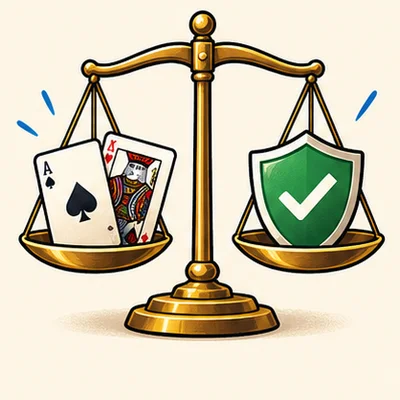 Obviously, no bet in blackjack would cause you to lose exactly $1 on any given $100 bet. However, if you played tens of thousands of hands, or looked at the aggregated results of thousands of customers playing at the casino, you would see that the casino was coming out ahead by about that 1% margin. This assumes of course that everyone plays perfect basic strategy. The reality is that casinos make more than that because of players that don’t know about basic strategy or prefer to gamble and bet with their gut when they are feeling lucky.
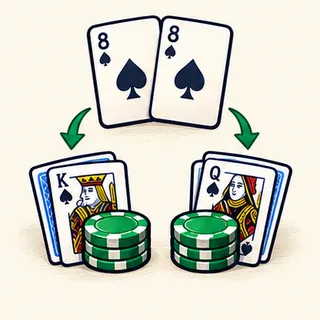 The following is a rundown of how different rule changes can affect the house advantage.
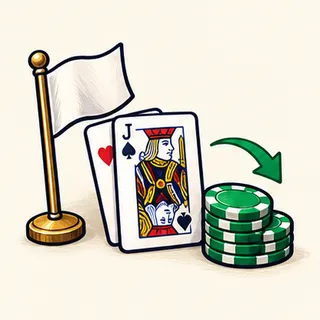 Changing the options available to the player can also have an impact on the house edge. For instance, allowing surrender, the option to hand in your cards and get half your money back before the hand is played, reduces the house edge. Allowing this before the dealer checks for blackjack is known as early surrender, while allowing it only after the dealer has checked for blackjack (and not received one) is known as late surrender. This is the effect of some common player-friendly rule variations:




 Bovada Casino